
Choosing a new boat is exciting, but when a manufacturer offers dozens of models across multiple series, figuring out where to start can be a little overwhelming. Sea Hunt makes that process easier once you understand how its lineup is organized.
The Sea Hunt Boats lineup has 25 models across three series: Ultra, Gamefish, and BX. Essentially, the Ultra Series is the all-around pick if you split your time between fishing and family days; the Gamefish Series is built for offshore anglers; and the BX Series is made for fishing the bays and flats. In this guide, we’ll walk through each series, point out a few models worth a closer look, and share some tips for finding the Sea Hunt that fits you best.
Sea Hunt has a classic family-business story. Father and son, Vic and Bubba Roof, started the company in 1995 in a one-room shop at a small plant outside Columbia, South Carolina with a simple goal: build an affordable boat that’s best in its class. To this day, Sea Hunt is still family owned and operated, still based in Columbia, and still staking its claim as the best-selling saltwater center console brand for 22 years straight.
Sea Hunt builds center consoles and bay boats, all made for saltwater fishing, with hull designs engineered with precision. The company designs its hulls to keep spray off the deck and soften the ride in chop. A signature Carolina flare at the bow deflects spray, and a sharper deadrise (the angle of the hull’s V-shape) helps the boat handle rough water. Deadrise changes along the hull, so Sea Hunt lists three numbers for each model, and the 50 to 60 degree figure is the sharper angle at the bow. According to Sea Hunt’s 2027 brochure, the larger bows give you longer, wider seating and extra under-seat storage, while the wider hull bottoms add stability and allow straighter hull sides, leaving more room inside.
Standard equipment is another big part of the Sea Hunt reputation. Every Sea Hunt comes with factory-installed Garmin electronics, a wireless phone charger, a sound system, and Yamaha power and props. Many Ultra and Gamefish models 23 feet and up include a side entry door as well, so be sure to check the impressive equipment lists for each model. Sea Hunt says its in-house tooling shop lets it design, build, and test its products, and it backs its boats with a structural hull warranty. Ask our team for the details.
Sea Hunt boats get sorted two ways, and knowing the difference makes shopping a lot easier. A category is the style of boat, like a center console or a bay boat. A series is one of Sea Hunt’s own product lines inside a category. Ultra and Gamefish are center console series, and BX is the bay boat series. For a closer look at how a center console is laid out, see our Anatomy of a Center Console Boat article. Our Getting to Know a Bay Boat article covers the bay boat style.
One more tip for reading the model names: the number is the boat’s approximate length in feet, so an Ultra 265 is 26' 5" long.
The Ultra Series is the biggest family in the Sea Hunt lineup, with 15 center consoles ranging from the Ultra 219 to the Ultra 305. If your weekends might include a morning of fishing, an afternoon cruise, and a stop at the sandbar with friends, this is a good place to start.
Here’s the range across the series:
The smaller Ultras are the easiest to trailer, launch, and store. That group includes the Ultra 219 (21'4"), Ultra 229 (22'8"), Ultra 234 (23'7"), Ultra 235SE (23'7"), Ultra 239SE (24'3"), and Ultra 245SE (24'3"). Max power is 200 hp on the 219, 250 hp on the 229, 234, and 235SE, and 300 hp on the 239SE and 245SE. Fuel capacity runs from 60 gallons on the 219 to 96 gallons on the 234 through 245SE.
These sizes are a great fit for bay fishing, trips around Charlotte Harbor, and short runs into the Gulf when the weather cooperates. We featured the Ultra 219 with its own article if you’d like to take a closer look.
Move up to the Ultra 255SE (24'11"), Ultra 265SE and 265SL (26'5"), or Ultra 275SE and 275SL (27'6") and you get more deck space for people and gear. Max power goes from 350 hp on the 255SE to 400 hp on the 265s and 500 hp on the 275s, and fuel capacity goes from 120 gallons to 145 and then 180. That kind of range puts nearshore reefs and wrecks within an easy day trip. As an example, the Ultra 265SL lists a 21-inch draft and a 10-gallon livewell.
The Ultra 285SE and 285SL (28'6") and the Ultra 305SE and 305SL (30'2") are the heavy hitters of the series. The 285s list 600 max hp and 180 gallons of fuel. The 305s list 700 hp and 230 gallons, and both sizes have a 9'9" beam. Our Ultra 305 SE article covers that model in more detail. Boats this size weigh 6,800 to 7,000 lbs dry.
Wondering which one to pick? On Sea Hunt’s website, the SE and SL versions of the 265, 275, 285, and 305 list the same length, beam, weight, power, and fuel capacity, so the difference is in the layout and features. The 265SL lists a 256-quart Sun Lounge storage compartment where the 265SE lists two 148-quart bow storage compartments. Compare the SE and SL pages for the size you like on Sea Hunt’s Ultra Series page, or stop in and we’ll walk you through the two side by side.
If fishing is the main event, the Gamefish Series is your lane. It is Sea Hunt’s offshore fishing line, with seven center consoles from 25' 8" to 30' 2". These boats are made for runs out to the Gulf’s reefs, ledges, and deeper water, where anglers go after grouper, snapper, kingfish, cobia, and amberjack.
Here’s the range across the series:
The Gamefish 27, 28, and 30 each come in an FS layout and a CB layout, while the Gamefish 25 comes in a single layout. Sea Hunt lists the same length, weight, power, and fuel for both layouts, so the choice is about how you want your deck set up.
Both 27-foot layouts list a rear bench seat, a 40-gallon livewell at the leaning post, and a 16-gallon transom livewell. They also share a 21-inch draft.
Fuel capacity is the number to watch for offshore trips. The 30 holds 230 gallons, while the 25 holds 145. The bigger boats also give you more room for a crew and a full day’s catch. To see what the CB layout looks like on the largest model, check out our Gamefish 30 with Coffin Box article.
Plenty of great fishing happens close to home, and that’s where the BX Series comes in. This series is Sea Hunt’s bay boat line, with three models made for the bays, flats, and backcountry inshore waters. Around Southwest Florida, that means places like Charlotte Harbor, Pine Island Sound, and Sarasota Bay, where anglers go after redfish, snook, trout, and tarpon.
Here’s the range across the series:
Here’s how the three models compare:
If you fish very shallow water, the 13-inch draft on the BX22BR is worth noting. Ask us for the draft on the other BX models.
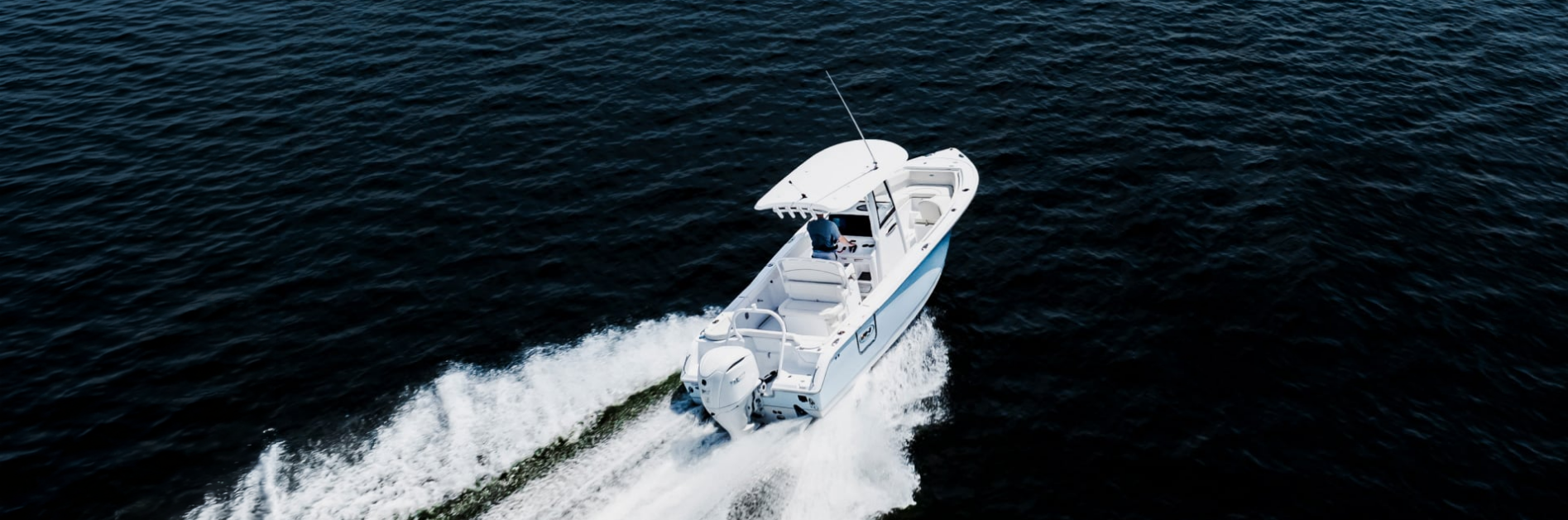
Ready to narrow it down? Start with where you boat, then work through crew, size, and power.
Many Sea Hunts can be trailered, but size decides how much work it is. Three things are worth checking before you buy.
The easiest boats to trailer are the 21- to 24-foot Ultras and the two smaller BX models. They’re the most likely to stay within the width limit, and their listed dry weights run from 2,350 to 3,900 lbs. The larger Ultras, the BX28, and the Gamefish models are wider and heavier, so plan on a permit, a heavy-duty trailer, and a truck that’s rated for the load. If you’re leaning toward one of those, ask us whether a trailer, a slip, or a lift makes the most sense for how you’ll use the boat.
Think about the people who come along on a typical trip, not the biggest group you might ever carry. A boat with room for four anglers and their rods is a different purchase than a boat that needs to seat six adults and a cooler. Gear matters too. Offshore trips call for more tackle, safety equipment, and ice than a morning on the flats, and that adds up to more deck and storage space.
A bigger boat costs more to run as well as to buy. It burns more fuel, needs a bigger trailer or slip, and costs more to insure and maintain. A smaller boat is easier on the wallet and can still cover the water you fish most often. Our team can help you think through those costs for any model you’re considering.
Every model lists a maximum horsepower. More power can improve speed and performance under load, within the boat’s rated limits; it doesn’t increase the boat’s capacity. Using more power usually increases fuel consumption. Fuel capacity across the lineup runs from 53 to 230 gallons. For offshore trips, many boaters use the rule of thirds as a starting point: plan to use one third of your fuel going out, one third coming back, and keep one third in reserve. Fuel use changes with load, speed, sea conditions, and route, so also check the boat’s actual fuel consumption and keep an adequate reserve.
Whether you’re headed for the flats or the reefs, there’s a Sea Hunt built for the way you fish. Ingman Marine carries Sea Hunt Boats and has locations in Port Charlotte, Sarasota, Placida, and Longboat Key. Stop by, bring your truck’s tow rating and the length of your slip, and we’ll help you narrow the list. You can also browse the Sea Hunt lineup online to see what’s available.
